 Add to Chrome
 Add to Firefox
 Add to Edge
Adaptive Auto-Harness: Sustained Self-Improvement for Agentic System Deployment on Open-Ended Task Streams
Jun 01, 2026
Auto-harness systems such as A-Evolve, GEPA, and Meta-Harness improve LLM agents by optimizing prompts, skills, tools, memories, and supporting infrastructure from execution feedback, but they are typically evaluated on fixed offline benchmarks. Real deployments instead present open-ended task streams: histories grow without a fixed endpoint, heterogeneous tasks require different harnesses, and problem distributions shift over time. These challenges make a single repeatedly and densely updated harness brittle, causing performance degradation as accuracy peaks early and then declines. This motivates sustained harness construction with task-wise adaptation. We introduce Adaptive Auto-Harness, a framework and system for such streams. The framework decomposes the gap to an oracle harness into evolution loss and adaptation loss. The system addresses these losses with a stateful multi-agent evolver, a harness tree with solve-time routing, and human-steering hooks for cases where history lacks the needed signal. Across prediction-market, security-competition, and event-forecasting streams, Adaptive Auto-Harness outperforms five existing auto-harness baselines and ablations attribute gains to better construction, routing, or targeted human steering. Code is available in https://github.com/A-EVO-Lab/AdaptiveHarness .

Learning Cardiac Latent Representations in Vectorcardiogram Space
May 29, 2026Electrocardiography (ECG) is a cornerstone of cardiac assessment, making the learning of informative ECG representations fundamental to tasks ranging from disease diagnosis to clinical report generation. However, existing methods operate almost exclusively in the observable ECG signal space. In practice, the standard twelve-lead ECG represents multiple projections of the same underlying cardiac electrical activity from different spatial orientations. Therefore, representation learning in the ECG space inevitably introduces substantial redundancy, which may lead to spurious correlations and increased risk of overfitting. To address this and motivated by the Frank vectorcardiogram (VCG) model, we propose learning a unified latent representation of cardiac electrical activity directly in the VCG space. We introduce LVCG, the first general self-supervised representation learning framework designed to operate in this physically grounded latent space. By learning view-invariant latent VCG representations rather than lead-specific artifacts, VCG minimizes redundancy and improves generalization. LVCG generally outperforms ECG-space baselines across tasks, demonstrating enhanced robustness and generalization, especially in domain shift settings.
An Empirical Study of Agent Skills for Healthcare: Practice, Gaps, and Governance
May 04, 2026Healthcare automation is shaped by local procedures and organizational constraints, so agent capabilities rarely transfer unchanged across settings. Agent skills, self-contained directories that package reusable procedures for AI agents, are emerging as a procedural layer for adapting healthcare agents across diverse healthcare settings. We present the first empirical analysis of healthcare agent skills, drawing on 557 healthcare-related skills filtered from 58,159 public skills on ClawHub and annotated along ten dimensions covering function, deployment context, autonomy, and safety. We find that public healthcare skills emphasize patient-facing workflow automation and monitoring rather than the diagnostic and treatment-oriented tasks foregrounded in healthcare-agent research; coverage of the healthcare lifecycle and specialized clinical inputs remains uneven; and general technical risk does not reliably capture clinical risk. These findings position healthcare skills as a procedural layer not yet addressed by current benchmarks and risk frameworks.
ECG-MoE: Mixture-of-Expert Electrocardiogram Foundation Model
Mar 04, 2026Electrocardiography (ECG) analysis is crucial for cardiac diagnosis, yet existing foundation models often fail to capture the periodicity and diverse features required for varied clinical tasks. We propose ECG-MoE, a hybrid architecture that integrates multi-model temporal features with a cardiac period-aware expert module. Our approach uses a dual-path Mixture-of-Experts to separately model beat-level morphology and rhythm, combined with a hierarchical fusion network using LoRA for efficient inference. Evaluated on five public clinical tasks, ECG-MoE achieves state-of-the-art performance with 40% faster inference than multi-task baselines.
Exposing Vulnerabilities in Explanation for Time Series Classifiers via Dual-Target Attacks
Feb 02, 2026Interpretable time series deep learning systems are often assessed by checking temporal consistency on explanations, implicitly treating this as evidence of robustness. We show that this assumption can fail: Predictions and explanations can be adversarially decoupled, enabling targeted misclassification while the explanation remains plausible and consistent with a chosen reference rationale. We propose TSEF (Time Series Explanation Fooler), a dual-target attack that jointly manipulates the classifier and explainer outputs. In contrast to single-objective misclassification attacks that disrupt explanation and spread attribution mass broadly, TSEF achieves targeted prediction changes while keeping explanations consistent with the reference. Across multiple datasets and explainer backbones, our results consistently reveal that explanation stability is a misleading proxy for decision robustness and motivate coupling-aware robustness evaluations for trustworthy time series tasks.
Patient-Conditioned Adaptive Offsets for Reliable Diagnosis across Subgroups
Jan 19, 2026AI models for medical diagnosis often exhibit uneven performance across patient populations due to heterogeneity in disease prevalence, imaging appearance, and clinical risk profiles. Existing algorithmic fairness approaches typically seek to reduce such disparities by suppressing sensitive attributes. However, in medical settings these attributes often carry essential diagnostic information, and removing them can degrade accuracy and reliability, particularly in high-stakes applications. In contrast, clinical decision making explicitly incorporates patient context when interpreting diagnostic evidence, suggesting a different design direction for subgroup-aware models. In this paper, we introduce HyperAdapt, a patient-conditioned adaptation framework that improves subgroup reliability while maintaining a shared diagnostic model. Clinically relevant attributes such as age and sex are encoded into a compact embedding and used to condition a hypernetwork-style module, which generates small residual modulation parameters for selected layers of a shared backbone. This design preserves the general medical knowledge learned by the backbone while enabling targeted adjustments that reflect patient-specific variability. To ensure efficiency and robustness, adaptations are constrained through low-rank and bottlenecked parameterizations, limiting both model complexity and computational overhead. Experiments across multiple public medical imaging benchmarks demonstrate that the proposed approach consistently improves subgroup-level performance without sacrificing overall accuracy. On the PAD-UFES-20 dataset, our method outperforms the strongest competing baseline by 4.1% in recall and 4.4% in F1 score, with larger gains observed for underrepresented patient populations.
EpiQAL: Benchmarking Large Language Models in Epidemiological Question Answering for Enhanced Alignment and Reasoning
Jan 06, 2026Reliable epidemiological reasoning requires synthesizing study evidence to infer disease burden, transmission dynamics, and intervention effects at the population level. Existing medical question answering benchmarks primarily emphasize clinical knowledge or patient-level reasoning, yet few systematically evaluate evidence-grounded epidemiological inference. We present EpiQAL, the first diagnostic benchmark for epidemiological question answering across diverse diseases, comprising three subsets built from open-access literature. The subsets respectively evaluate text-grounded factual recall, multi-step inference linking document evidence with epidemiological principles, and conclusion reconstruction with the Discussion section withheld. Construction combines expert-designed taxonomy guidance, multi-model verification, and retrieval-based difficulty control. Experiments on ten open models reveal that current LLMs show limited performance on epidemiological reasoning, with multi-step inference posing the greatest challenge. Model rankings shift across subsets, and scale alone does not predict success. Chain-of-Thought prompting benefits multi-step inference but yields mixed results elsewhere. EpiQAL provides fine-grained diagnostic signals for evidence grounding, inferential reasoning, and conclusion reconstruction.
STReasoner: Empowering LLMs for Spatio-Temporal Reasoning in Time Series via Spatial-Aware Reinforcement Learning
Jan 06, 2026Spatio-temporal reasoning in time series involves the explicit synthesis of temporal dynamics, spatial dependencies, and textual context. This capability is vital for high-stakes decision-making in systems such as traffic networks, power grids, and disease propagation. However, the field remains underdeveloped because most existing works prioritize predictive accuracy over reasoning. To address the gap, we introduce ST-Bench, a benchmark consisting of four core tasks, including etiological reasoning, entity identification, correlation reasoning, and in-context forecasting, developed via a network SDE-based multi-agent data synthesis pipeline. We then propose STReasoner, which empowers LLM to integrate time series, graph structure, and text for explicit reasoning. To promote spatially grounded logic, we introduce S-GRPO, a reinforcement learning algorithm that rewards performance gains specifically attributable to spatial information. Experiments show that STReasoner achieves average accuracy gains between 17% and 135% at only 0.004X the cost of proprietary models and generalizes robustly to real-world data.
An Adaptive Machine Learning Triage Framework for Predicting Alzheimer's Disease Progression
Nov 10, 2025Accurate predictions of conversion from mild cognitive impairment (MCI) to Alzheimer's disease (AD) can enable effective personalized therapy. While cognitive tests and clinical data are routinely collected, they lack the predictive power of PET scans and CSF biomarker analysis, which are prohibitively expensive to obtain for every patient. To address this cost-accuracy dilemma, we design a two-stage machine learning framework that selectively obtains advanced, costly features based on their predicted "value of information". We apply our framework to predict AD progression for MCI patients using data from the Alzheimer's Disease Neuroimaging Initiative (ADNI). Our framework reduces the need for advanced testing by 20% while achieving a test AUROC of 0.929, comparable to the model that uses both basic and advanced features (AUROC=0.915, p=0.1010). We also provide an example interpretability analysis showing how one may explain the triage decision. Our work presents an interpretable, data-driven framework that optimizes AD diagnostic pathways and balances accuracy with cost, representing a step towards making early, reliable AD prediction more accessible in real-world practice. Future work should consider multiple categories of advanced features and larger-scale validation.
Generalist vs Specialist Time Series Foundation Models: Investigating Potential Emergent Behaviors in Assessing Human Health Using PPG Signals
Oct 16, 2025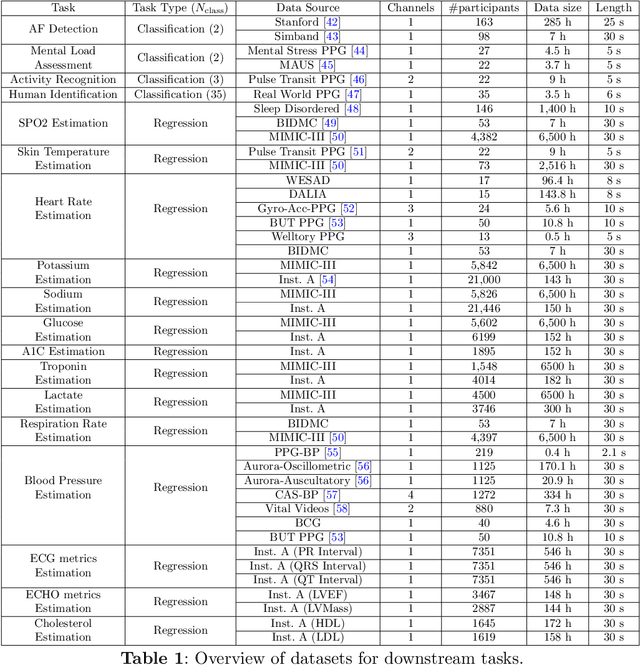
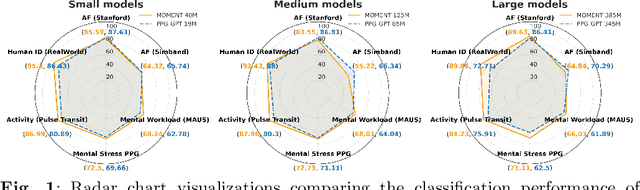
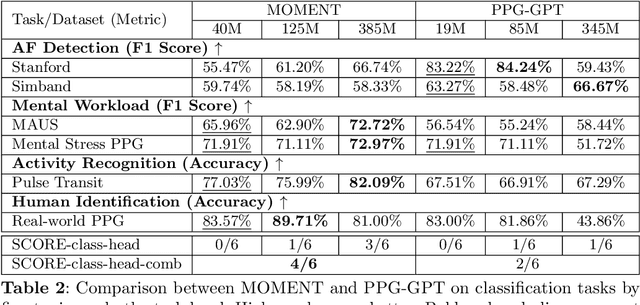
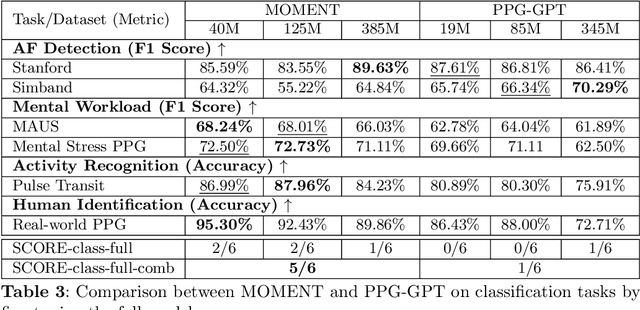
Foundation models are large-scale machine learning models that are pre-trained on massive amounts of data and can be adapted for various downstream tasks. They have been extensively applied to tasks in Natural Language Processing and Computer Vision with models such as GPT, BERT, and CLIP. They are now also increasingly gaining attention in time-series analysis, particularly for physiological sensing. However, most time series foundation models are specialist models - with data in pre-training and testing of the same type, such as Electrocardiogram, Electroencephalogram, and Photoplethysmogram (PPG). Recent works, such as MOMENT, train a generalist time series foundation model with data from multiple domains, such as weather, traffic, and electricity. This paper aims to conduct a comprehensive benchmarking study to compare the performance of generalist and specialist models, with a focus on PPG signals. Through an extensive suite of total 51 tasks covering cardiac state assessment, laboratory value estimation, and cross-modal inference, we comprehensively evaluate both models across seven dimensions, including win score, average performance, feature quality, tuning gain, performance variance, transferability, and scalability. These metrics jointly capture not only the models' capability but also their adaptability, robustness, and efficiency under different fine-tuning strategies, providing a holistic understanding of their strengths and limitations for diverse downstream scenarios. In a full-tuning scenario, we demonstrate that the specialist model achieves a 27% higher win score. Finally, we provide further analysis on generalization, fairness, attention visualizations, and the importance of training data choice.